Life as a box man
The Box ManLife as a box man is neither simply hiding inside a cardboard enclosure nor disappearing from society: it is a daily practice of adapting a fragile shelter to the demands of the street. The narrator describes its equipment, routines, bodily costs, and peculiar experience of time, while arguing that the Box man’s invisibility exposes how readily ordinary urban life overlooks people who lack recognized identities. The account moves between instruction and reflection, treating survival as a craft and social nonrecognition as one of its defining conditions.
Definition and Social Position
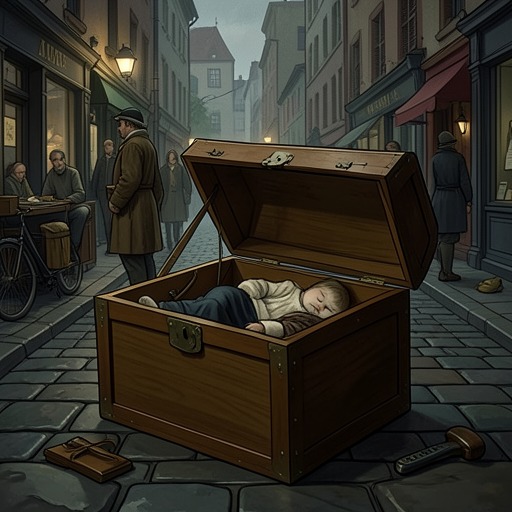
The Box man occupies an unstable boundary between person and object. The narrator describes someone who puts a paper enclosure over his head and goes out into the streets as an apparition that is neither quite man nor box. The covering conceals the whole body, but concealment does not make its wearer genuinely invisible: people may encounter a Box man and still avert their eyes, unwilling to acknowledge what they have seen. The narrator suggests that such figures live in concealment across the country, although there are no statistics and public discussion of them is absent. This silence makes their social position difficult to measure and, in the narrator’s account, helps sustain it.
The account also imagines an anonymous city in which people can move among strangers without having to defend themselves or justify unconventional behavior. That imagined freedom is not a secure refuge: A’s experience shows that becoming a Box man exposes a person to dangers that others might dismiss or ignore. The narrator’s warning against pointing a gun at a Box man underscores the vulnerability behind the apparent armor of the box. Its shelter is also a visible sign that its occupant stands outside familiar forms of recognition.
The narrator extends this argument into a deliberately unsettling claim about law. Referring to the Nagoya Superior Court euthanasia precedent, he argues that a person whose existence is not legally recognized cannot be understood through the ordinary protections and categories applied to recognized members of society. In this reasoning, violence against a Box man is framed not as a conventional crime but as an act occurring beyond law’s reach. This is the narrator’s radical interpretation, not a neutral account of the law; its force lies in exposing the consequence of treating a person as if he were already absent from the legal order.
Equipment and the Work of Survival
The box must be modified before it can function as a dwelling. Its viewing slit is more than a peephole: small changes in its opening let the wearer adjust what can be seen and communicate an expression. The narrator regards the slit’s threatening appearance as one of the few defenses available to an unprotected Box man. Additional holes in the side walls can help distinguish the direction of sounds as well as provide further sightlines, though they must be arranged carefully so the cardboard retains its strength. Even the flaps cut for rain are oriented with use in mind.
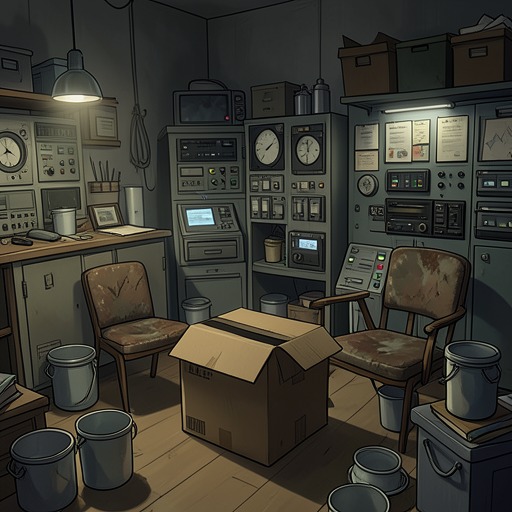
Inside, space is scarce and every object has to earn its place. Short lengths of leftover wire, bent into hooks, can hang possessions on the wall, but the narrator advises keeping personal effects to a minimum. The indispensable items include a radio, mug, thermos, flashlight, towel, and small bag. Rubber boots need only be sound, while canvas wrapped around the waist helps fill the gap between the body and the box and keep the enclosure in place. These are not decorative adjustments: they make movement and routine bodily functions possible while preserving the box as a usable shelter.
A plastic board shows how ordinary objects acquire several purposes in this life. The narrator describes one measuring sixteen by eighteen inches, milky white and thick enough to provide a stable surface. It serves as a table for eating and card fortune-telling, a chopping board, a rain shutter over the observation window, a fan, a portable seat, and a work surface for preparing collected cigarette butts. Its value comes from versatility rather than permanence. The narrator recalls having once accumulated assorted objects on the chance that they might prove useful, before learning to pare possessions down to what daily life required.
Bodily Adaptation and Daily Routine
The first summer days in a box bring a trial of heat and discomfort. The narrator describes persistent sweat, dirt, and irritation as difficulties that can make the new life hard to endure; even the prospect of cooling off near the air-conditioning outlet at a building entrance offers only limited relief. After four or five days, however, the body seems to adjust, or at least to become less troubled by the conditions. The narrator treats this adaptation as a test of experience: a person who has not undergone the ordeals cannot claim the same knowledge as someone who has lived them. The point is not that hardship disappears, but that the Box man learns to inhabit conditions that initially seem intolerable.
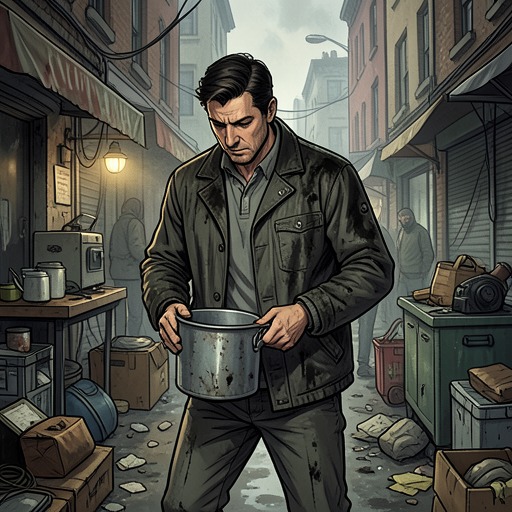
Most days, the narrator says, pass without incident. Self-consciousness and embarrassment about other people’s attention gradually diminish, while eating, sleeping, and finding places for necessary routines remain unavoidable. Food is a particular problem because the Box man must leave shelter when supplies run out. The narrator distinguishes collecting leftovers from ordinary begging, emphasizing both the practical need to avoid trouble and a lingering concern with hygiene. Over three years, he says, the smell of mixed leftovers remains difficult to get used to. He describes searching for food that is dry and comparatively odorless, while noting that restaurants’ larger quantities of discarded food are collected for hog farms and that more durable items can be hard to find. The city’s waste offers a resource, but not one that can be used without judgment or effort.
The City, Time, and Invisibility
Foraging also serves a purpose beyond obtaining food: it teaches the Box man how to move through town. The narrator says that food can be obtained from store counters, but that gathering leftovers provides an opportunity to become familiar with the city and its crowds. Once that familiarity develops, the experience of time changes. The background seems to rush past, the foreground moves slowly, and the center around the Box man becomes still. On this account, boredom belongs to the fake Box man, not to the person whose attention has learned to inhabit the city at several speeds at once.
The contrast between urban bustle and social inattention appears in the report of a forty-year-old man found dead in the underground passage at the West Exit of Shinjuku Station. He had reportedly sat in the same position from noon until evening amid commuters and shoppers, while hundreds of thousands of passengers used the passage each day. He possessed only a small amount of change and newspapers, and nothing that established his name or residence. Although he was near a police box, an officer said he could not be seen from the other side of a pillar. The man is not identified as a Box man, but the report sharpens the narrator’s account of invisibility: crowded public space can contain a person without producing recognition or response.
The narrator’s own notes begin under a bridge over a canal on a rainy night, illuminated by a flashlight. He considers the shelter unsuitable and the use of an electric light extravagant, because people living on the road should make use of things found in the street and can often read by streetlamps. This scene makes the practice concrete: even the act of writing is weighed against the habits and economy of a life outdoors. The notes also record that the box has been sold to a woman willing to pay fifty thousand yen, placing the narrator’s account at a moment when his familiar shelter is about to change hands.
Shared Life and the Limits of the Box
In the Hospital, the narrator describes a period of life shared with a woman after the door’s nameplate and sign have been removed and the red lamp at the gate extinguished. Once a day he puts on the box and goes into town to gather daily necessities, principally food. If he avoids entering any one store more than once a month, he believes he is unlikely to be challenged. The arrangement provides comfort without abundance, and he imagines that the two could continue living that way for years. The box thus functions not only as a means of solitary concealment but also as part of a restricted domestic routine.
Their shared life contracts around an intimate space and a narrowed field of attention. The narrator says they rarely go beyond an eight-foot circle and that words gradually lose their importance; he feels himself dissolving into parts rather than being regarded as a whole personality. He and the woman do not seriously imagine the future, even as waste accumulates in an unused kitchen and the room grows increasingly neglected. The account connects this closed domestic world to the same altered sense of time that accompanies life as a Box man: days can pass without meaningful distinction, while the end of an attachment may arrive at once.
That arrangement does not last. One day the woman appears dressed and silent, and the narrator, still naked in his box, returns to it as she withdraws to her room. He wonders whether they might begin again, but the scene marks the failure of the enclosed life they had sustained together. Across these episodes, the box offers a working shelter and a way to move through the city without ordinary recognition; it cannot guarantee security, social acknowledgment, or permanence. Its meaning lies in that tension between the practiced freedom it permits and the isolation it cannot resolve.